
Published October 19, 2026
Clark County Growth Plan: What It Means for Buyers and Sellers

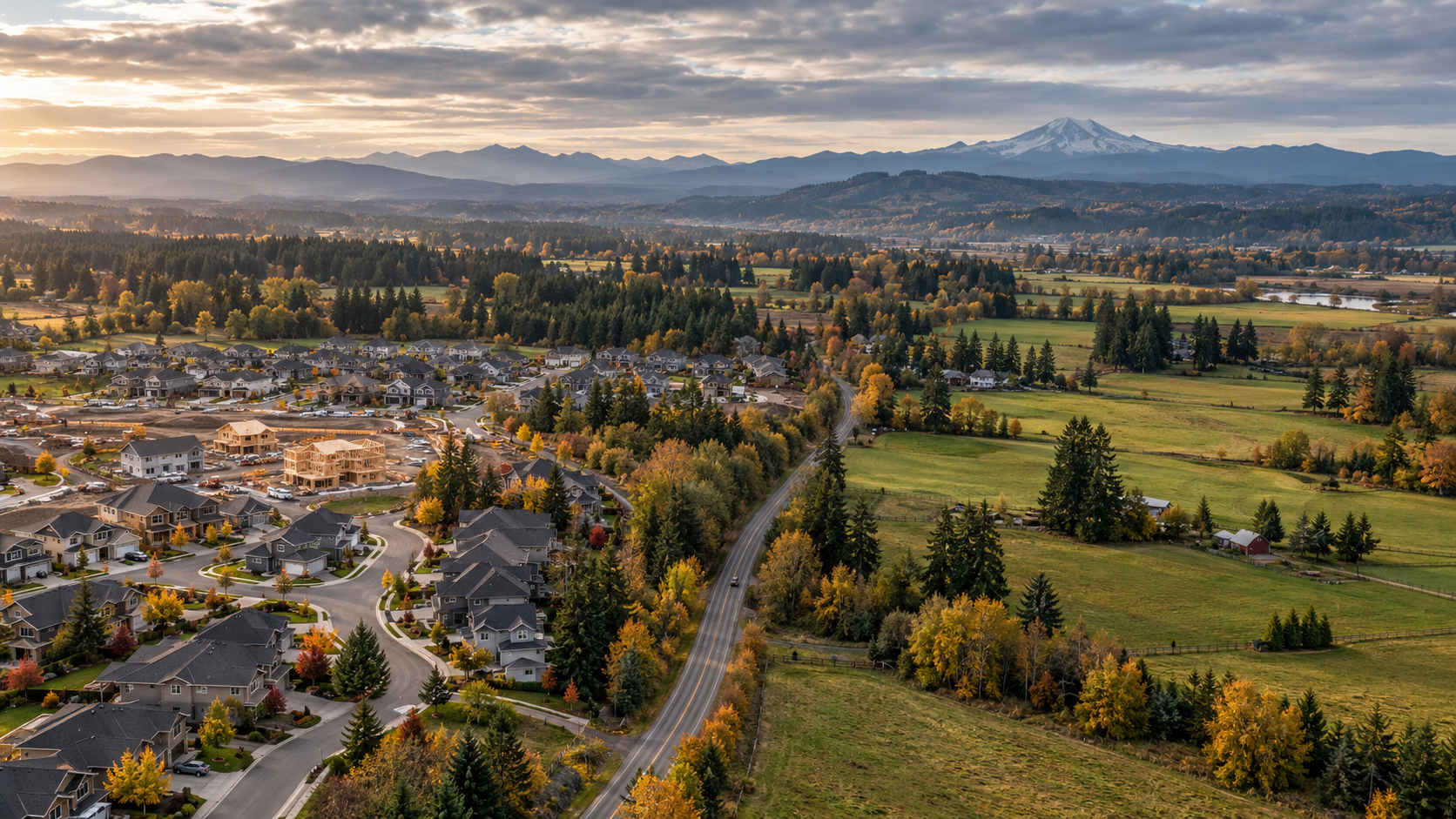
What does Clark County's new 20-year growth plan mean if you're buying or selling?
On October 13, 2026, the Clark County Council unanimously adopted ordinance 2026-10-01, a more than 400-page update to the county's 20-year comprehensive growth plan. It expands the urban growth areas around Ridgefield, La Center, Battle Ground, and Camas, rewrites rural cluster development standards, and updates the school, transportation, and new fire impact fees that new construction pays. Nothing about your property's zoning changed overnight, and the plan can still be appealed to the state Growth Management Hearings Board for 60 days after the county publishes its Notice of Adoption on October 23.
By Rick Sadle | October 19, 2026
Three years of hearings came down to one vote last Tuesday, and my phone started ringing the next morning.
The questions were all versions of the same thing: does this change what my property is worth, and does it change what I can do with it?
For most homeowners in Vancouver, Camas, and Washougal, this plan won't change much in the next 12 months. For people buying new construction in north county, and for anyone sitting on rural acreage, it changes real money and real timelines — and one piece of it is still unsettled.
Here's what I'd want to know if it were my property.
What the council actually adopted
The update is the county's required rewrite of its growth plan under Washington's Growth Management Act, and it plans for a county of 718,154 people by 2045. Clark County has about 577,431 residents today, so the plan is built around roughly 140,700 more neighbors — a 24% increase — plus 73,500 more jobs on top of the roughly 180,900 here now.
The adopted package covers a lot of ground:
- A new Climate Element and multi-modal transportation standards
- Updated housing policies, with an emphasis on housing at all income levels
- Changes to the comprehensive plan and zoning maps
- Changes to county code Title 40 to implement those maps and policies
- An updated Arterial Atlas and Capital Facilities Plans
- Updated school and transportation impact fees, plus new fire impact fees
For real estate, the biggest change is the expansion of the urban growth areas. Ridgefield, La Center, Battle Ground, and Camas all got room to grow.
This can be the cofusing part. Being brought into an urban growth area is not a rezone, and it is not a building permit. It means the county now expects that land to become urban eventually. Annexation into the city, water and sewer extension, a plat application, and subdivision approval are all separate steps that come later — often years later, and usually in that order.
I've watched sellers price acreage as though a UGA line on a map were a signed subdivision approval. It isn't. If someone tells you your five acres just became buildable lots, ask them which city will annex it, and when the sewer gets there.
The number that shows up in the price you pay
If you're buying new construction in unincorporated Clark County, pay close attention to the impact fees. The difference from one area to another is substantial.
These are the school impact fees per new single-family home that Clark County currently publishes (its schedule is marked Rev 9.15.23):
- Ridgefield — $16,880.00
- Battle Ground — $10,760.00
- Hockinson — $7,790.00
- Camas — $6,650.00
- Evergreen — $6,432.00
- Woodland — $5,900.00
- La Center — $3,501.00
- Vancouver — $2,786.09
- Green Mountain and Washougal — $0
Two otherwise identical new homes, one in the Ridgefield school area and one in the Vancouver school area, carry a $14,093.91 difference in school impact fees alone. That's more than six times the fee for essentially the same house.
Transportation impact fees stack on top of that, and they also vary by where you are — from $3,220.62 in the rural area to $8,520.88 in Mt. Vista, per new single-family home, with a separate $3,500.00 surcharge in parts of the 179th Street development area. Park impact fees add roughly $1,998 to $5,572 depending on the park district.
The builder writes the check at permit issuance. You pay it in the purchase price. That's why the same floor plan can cost more just five miles away. Ask about it before you fall in love with the house.
There are three things you need to know about those numbers:
- They apply to unincorporated Clark County. If you're buying inside Vancouver, Camas, or Washougal city limits, the city's own fee schedule governs.
- The county's published schedule is dated 2023. The council adopted fee changes on September 15, 2026, and local reporting described significant moves — La Center's single-family school fee rising from $3,501 to $7,536, Hockinson's from $7,790 to $15,175, and Evergreen's dropping to $0 on falling enrollment. I have not been able to confirm those new figures against the county's own published schedule, so treat them as reported rather than verified.
- Verify before you sign. Ask the builder for the actual fee schedule in effect for your permit, in writing.
I check this for clients before they write an offer on a new build. A $14,000 fee difference is real money, and it won't show up in a Zillow estimate. If you want help understanding what else lands in your closing costs, that's a short conversation.
If you own rural acreage, watch this one
Early in October, the council approved new development standards for rural cluster developments — the approach that concentrates homes on smaller parcels while preserving the remaining open space. The changes would let owners of agricultural and resource land divide out small parcels for eventual development while keeping the balance of the land intact.
But the issue isn't settled.
At the October 13 meeting, Councilor Matt Little asked to reconsider his vote. Chair Sue Marshall proposed a six-month moratorium on rural cluster development so the council could study the issue further, and the council must hold a public hearing on that moratorium within 60 days — by roughly December 12.
To be clear about status: that moratorium was proposed, not adopted. As of this writing I have found no record that the council has voted on it. Councilors raised real concerns, including whether the existing code has been applied consistently and whether clustering is being used for conservation or for income.
If a cluster division is part of why you're holding the land—or part of what you're paying for it—your timeline is uncertain right now. Don't price acreage on the assumption that today's standards will be the standards in March. If you're mid-decision, watch the council's hearing calendar, and build the uncertainty into your plan rather than hoping it resolves your way.
The plan isn't fully locked in yet
The final update went to the Washington State Department of Commerce, and the county will issue its Notice of Adoption on October 23, 2026.
The 60-day appeal clock starts with that notice. Under RCW 36.70A.290(2)(b), a petition challenging a county's plan must be filed within 60 days after the county publishes its notice of adoption — which puts the deadline around December 22, 2026. Appeals go to the state Growth Management Hearings Board, and a successful challenge can send pieces of a plan back to the county for another round.
Growth plans in this county have drawn organized opposition before, particularly over agricultural land. I'm not predicting an appeal. I'm telling you the window is open, so "it's final" isn't quite true until it closes.
If you're buying: Ask whether the parcel is inside or outside a UGA, and whether it's in a newly added area. Get the impact fee schedule in writing on any new build. If the home's value depends on future development potential, treat that potential as unpriced until the entitlements exist.
If you're selling: A nearby UGA expansion may help the marketing story, but it doesn't automatically add a specific amount to the property's value. Buyers and appraisers pay for what the property can do today. If you own rural land where clustering matters, the pending moratorium question belongs in your pricing conversation, not hidden from it.
If you're weighing a move in Clark County, don't start with the 2045 projections. Start with what your specific parcel can legally do in the next six months. That's the piece I'm happy to look at with you. You may also want to read how the City of Vancouver's own zoning changes affect homeowners inside city limits, since that's a separate set of rules from the county's.
Frequently Asked Questions
Does Clark County's new growth plan rezone my property?
Not by itself, in most cases. The plan did change comprehensive plan and zoning maps for specific areas, so some parcels were affected directly — but being inside a newly expanded urban growth area is not the same as being rezoned or being ready to build. Check your specific parcel with Clark County Community Development before you make a decision based on it.
Will my property taxes go up because of the growth plan?
The growth plan is a land use document, not a tax measure, and it doesn't set your levy rate. Your assessed value can change over time if what your land can legally be used for changes, which is a separate process. For how the two states compare on the tax side, see our breakdown of property taxes in Portland versus Vancouver, and confirm your own assessment with the Clark County Assessor.
Who actually pays Clark County impact fees — the builder or the buyer?
The builder or developer pays the fee when the building permit is issued, which means it's generally built into the price you're quoted for a new home. That's why comparing the same floor plan across school and traffic areas can produce a meaningfully different price. Ask for the fee schedule that applies to your permit in writing.
Can the new growth plan still be challenged?
Yes. The county issues its Notice of Adoption on October 23, 2026, and under state law a petition for review must be filed with the Growth Management Hearings Board within 60 days of that publication — roughly December 22, 2026. A successful appeal can remand parts of the plan back to the county.
Is now a bad time to buy rural land in Clark County?
It depends entirely on whether your plan relies on dividing the land. If you're buying acreage to live on, the pending rural cluster questions matter very little. If you're buying it for cluster development potential, the proposed six-month moratorium is an open risk, and I'd want that reflected in your price and your contingencies.
Where this leaves you
Clark County has set its direction for the next two decades, but most properties won't see an immediate change. The pieces that matter right now are narrow and specific: impact fees if you're buying new construction, cluster standards if you own rural acreage, and an appeal window that stays open until late December.
If you want to know what this means for your address, I can pull the parcel details and walk through the numbers with you. Reach out anytime.
Sources
- Clark County, Clark County adopts 20-year growth plan — adoption date, ordinance 2026-10-01, plan contents, population and employment projections, Notice of Adoption date, appeal process
- Clark County Community Development, Residential Impact Fees — school, traffic, and park impact fee schedules (marked Rev 9.15.23)
- Washington State Legislature, RCW 36.70A.290 — 60-day petition deadline following a county's notice of adoption
- Clark County, 2025 Comprehensive Plan Update — hearing schedule, scope of the proposal, Final EIS coverage
- The Columbian, Clark County Council approves 20-year growth plan — unanimous vote, rural cluster standards, proposed six-month moratorium
- The Columbian, Clark County Council approves nearly 100 changes to comprehensive plan — urban growth boundary expansions for Ridgefield, La Center, Battle Ground, and Camas
- Clark County Today, Clark County Council approves increases to current impact fees, as well as new impact fees — reported September 15, 2026 fee changes and new fire district impact fees
A note on this post: I'm a real estate broker, not a CPA, an attorney, or a land use planner. Impact fees, zoning, and growth management law are technical and they change. Nothing here is tax or legal advice. Confirm your specific parcel, fees, and timelines with Clark County Community Development, and talk to a land use attorney or CPA about your own situation before you act.
About Rick Sadle
Rick Sadle is the Principal Broker and CEO of The Sadle Home Selling Team at Keller Williams Realty Professionals, serving the Portland, Oregon and Vancouver, Washington real estate markets. With more than 20 years of real estate experience, over 3,500 homes sold and more than $1 billion in team sales volume, Rick is one of the Portland area's most experienced real estate professionals. He is also a weekly real estate expert on KXL 101 FM, where he discusses the Portland and Vancouver housing markets, mortgage rates, housing trends and the economy. Rick is an Oregon-licensed Principal Broker and Washington-licensed Broker.
or another way