
Published November 2, 2026
Selling a House in a Living Trust: Oregon vs. Washington

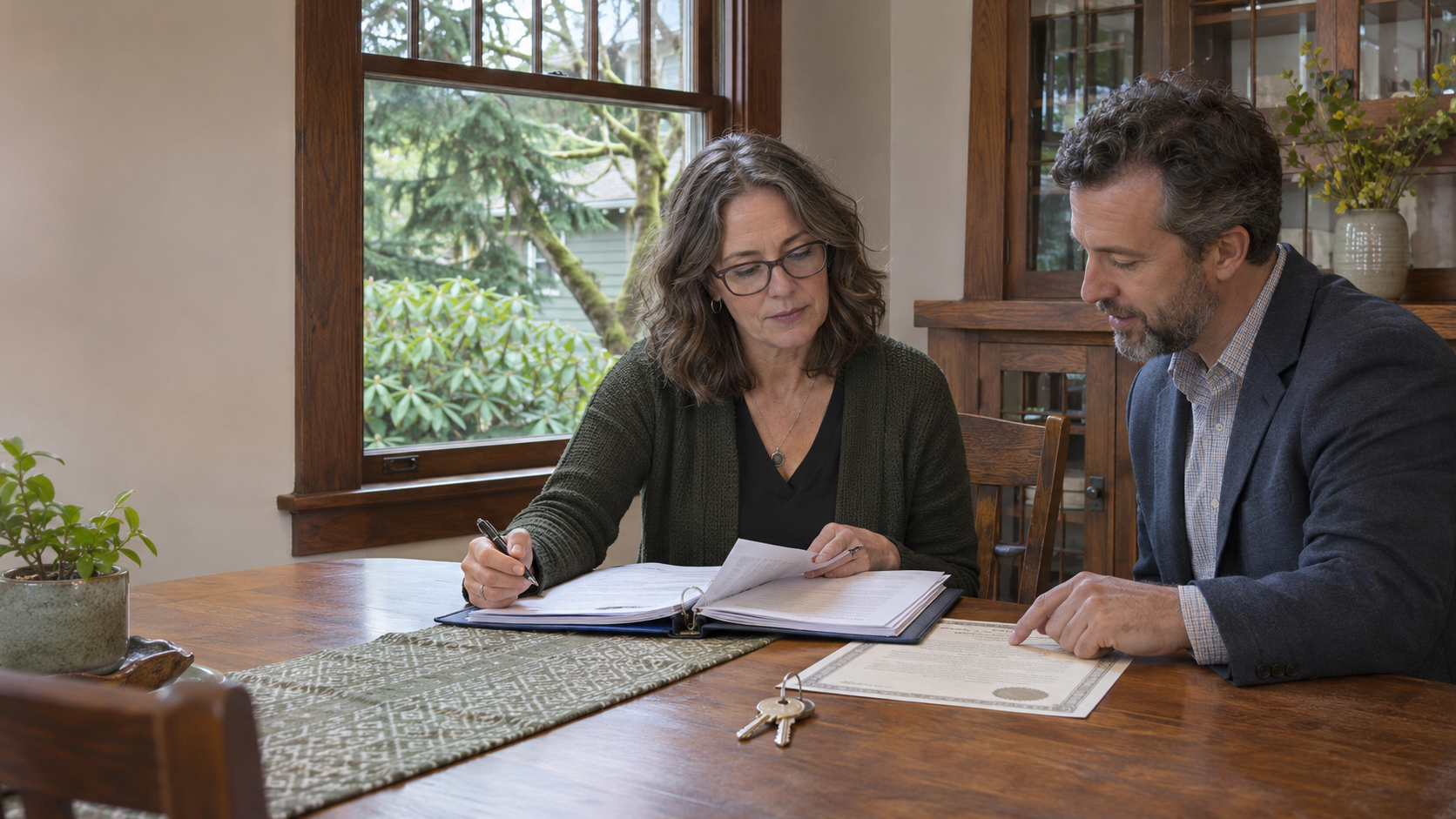
Can a trustee sell a house held in a living trust in Oregon or Washington?
Yes. A successor trustee can sell a home held in a revocable living trust without opening probate, and in most cases without a court order. What the trust does not change is just as important: in both Oregon and Washington, you generally still need to complete the seller disclosure form, and in Washington the full real estate excise tax still applies. The trust changes who signs and how you prove authority — not what the sale costs.
By Rick Sadle | November 2, 2026
I hear this from families throughout the Portland and Vancouver area, usually when things are already moving quickly. A parent has died or moved into care, and an adult child finds a trust document that has not been opened in years. The house is often the largest asset in it.
When the house was properly deeded into a revocable living trust, the successor trustee can usually move forward without opening probate, getting letters testamentary, or waiting on a court calendar in Multnomah or Clark County. That can remove months of delay from the process.
Three issues cause most of the delays in a trust sale. It is worth sorting them out before you sign a listing agreement.
Proving you have the authority to sell
Escrow will not take your word for it, and it should not have to. Both states give you a short document that does the job without handing your family's private business to strangers: a certification of trust.
It confirms that the trust exists, who created it, who is currently trustee, what powers that trustee has, whether the trust is revocable, and how title is held. What it leaves out is the part you care about keeping private — Oregon's statute says plainly that a certification "need not contain the dispositive terms of a trust." Who inherits what stays out of it.
Oregon and Washington handle the signatures differently:
- Oregon requires every trustee to sign. Under ORS 130.860(3), a certification of trust "must be signed or otherwise authenticated by all the trustees." If your mother named you and your brother as co-trustees and your brother is in another state, that signature is not optional — start chasing it now, not the week before closing.
- Washington is looser about who signs. RCW 11.98.075(2) lets any trustee, or the trust's attorney, sign the certification.
- Neither state lets a buyer demand the whole trust. Oregon's ORS 130.860(6) says a recipient "may not require the trustee to furnish the entire trust instrument," though they can ask for the excerpts that name the trustee and grant the power to act. Washington goes a step further: under RCW 11.98.075(8), someone who demands the full trust on top of a certification can be liable for damages and attorney fees if a court finds the demand was not made in good faith.
In practice, a title company here will want the certification, the excerpts naming the successor trustee, a death certificate if the person who created the trust has died, and the recorded deed showing the house is actually titled in the trust's name.
The recorded deed is the first thing to check. Some people sign a trust but never transfer the home into it — the lawyer drafts the trust, the deed is never recorded, and the house remains in the parent's individual name for years. If the deed never moved, the trust is empty as to that house, and you are headed for probate after all. Check the recorded deed before you do anything else. It takes one phone call to the county.
The disclosure form you probably still have to fill out
Many trustees assume the trust exempts them from the seller disclosure form. In both states, that assumption is usually wrong, and it is wrong in a way that creates real liability.
In Oregon, ORS 105.470(3) does exempt trustees — but only those "appointed by a court." A successor trustee of a living trust is appointed by the trust document, not by a judge. The exemption does not reach you. You owe the Seller's Property Disclosure Statement.
In Washington, RCW 64.06.010 lists seven exceptions to the Form 17 requirement. One covers "a transfer made by the personal representative of the estate of the decedent or by a trustee in bankruptcy." A trustee of a living trust is neither. Form 17 applies.
That can leave you answering detailed questions about a roof, a furnace, and a crawl space in a house you have never lived in. You are not required to know things you do not know — "don't know" is a legitimate answer on both forms, and a far safer one than a guess. But you are required to disclose what you do know, including anything a sibling or a caregiver has told you.
Two practical moves here. Get a pre-listing inspection, so the answers come from a professional rather than your memory. And talk to whoever actually lived in or maintained the house before you fill anything in.
One Washington-only note: under RCW 64.06.010(7), a buyer can expressly waive Form 17 — except the Environmental section, which cannot be waived if any answer in it would be "yes."
The trust saved you probate, not excise tax
The Washington tax treatment is separate from the probate question.
Moving a house into a revocable trust is free of excise tax. Washington's rule, WAC 458-61A-211(2)(g), exempts "a transfer into any revocable trust" as a mere change in form — beneficial ownership did not change, so there is nothing to tax.
Selling it out of the trust to a buyer is a different transaction. The same rule, WAC 458-61A-211(2)(h), says it directly: "A sale of real property by the trustee to a third party, or to a beneficiary for valuable consideration, is subject to the real estate excise tax."
So a trustee selling a Vancouver home for $700,000 pays what any other seller pays. Using Washington's current graduated state rates — 1.10% on the first $525,000 and 1.28% above that — plus the 0.50% local rate in Vancouver, that is $8,015 in state excise tax and $3,500 locally, or $11,515 total, roughly 1.65% of the sale price. The trust does not reduce it by a dollar.
Oregon has no statewide transfer tax, which is one of the real cost differences between selling in Vancouver and selling in Portland. Washington County is the state's lone grandfathered exception, so confirm with your escrow officer if your home is in Beaverton, Tigard, or Hillsboro.
What about capital gains?
For the federal home-sale exclusion, a revocable living trust generally does not change the result while the grantor is alive.
While the person who created the trust is alive, the IRS treats them as the owner. The federal regulation is explicit: under 26 CFR 1.121-1(c)(3)(i), where a residence is owned by a trust and the taxpayer is treated as the owner under the grantor trust rules, that taxpayer "will be treated as owning the residence" for the two-year ownership test, "and the sale or exchange by the trust will be treated as if made by the taxpayer." Translated: putting your house in a living trust does not cost you the $250,000 or $500,000 home sale exclusion.
After a death, the analysis shifts to date-of-death value and who reports the sale, and that is genuinely a question for a CPA — the gain calculation on a home sale here turns on details that vary family to family. Get the basis number in writing from a tax professional before you accept an offer, not after.
What I tell trustees before we list
Handle these four items early and the sale is usually straightforward:
- Pull the recorded deed and confirm the house is actually titled in the trust.
- Get the certification of trust drafted early — and in Oregon, get every co-trustee's signature on it before you need it.
- Order a pre-listing inspection so your disclosure answers rest on a professional's findings rather than your recollection.
- Call a CPA about basis if the person who created the trust has died.
None of that is expensive. Skipping it is — I have watched trust sales lose two weeks at the closing table over a co-trustee signature nobody thought to collect, and escrow timelines in Oregon and Washington leave less slack than people expect.
Frequently Asked Questions
Do I need to go through probate if the house is in a living trust?
No — that is the entire point of funding the trust. A successor trustee can sell directly. The exception is a house that was never actually deeded into the trust, which lands back in probate regardless of what the trust document says.
Does a buyer get to read my family's trust?
No. A certification of trust is what they are entitled to, plus excerpts showing the trustee's authority. Oregon's ORS 130.860(6) bars a demand for the entire instrument, and Washington's RCW 11.98.075(8) attaches damages to a bad-faith demand for it.
Do I have to fill out the seller disclosure form as a trustee?
In both states, generally yes. Oregon's exemption at ORS 105.470(3) reaches only court-appointed trustees, and Washington's list of Form 17 exceptions at RCW 64.06.010 covers bankruptcy trustees and estate personal representatives, not living-trust trustees. Answer "don't know" rather than guessing where you genuinely do not know.
Did putting the house in a trust trigger Washington excise tax?
No. WAC 458-61A-211(2)(g) exempts a transfer into any revocable trust. The excise tax arrives when the trustee sells to a buyer.
All the co-trustees have to sign in Oregon — what if one won't?
Read the trust first; many name a tiebreaker or let a majority act, and some let a trustee resign and pass authority to the next in line. If the document offers no path, that becomes a question for a trusts attorney rather than a real estate problem.
What to confirm before you list
A properly funded living trust can let a successor trustee sell without probate, but it does not remove the normal disclosure obligations or Washington excise tax. In Oregon, plan ahead for every co-trustee's signature on the certification.
If you are holding a trust document and a set of keys and you are not sure what comes next, I'm happy to walk through it with you — including what the house will realistically sell for and what you'll net after costs. Reach out anytime.
Sources
- ORS 130.860 — Certification of trust (Oregon Revised Statutes, chapter 130)
- RCW 11.98.075 — Certification of trust (Washington State Legislature)
- ORS 105.465 and ORS 105.470 — Seller property disclosure application and exclusions
- RCW 64.06.010 — Exceptions to the seller disclosure statement
- WAC 458-61A-211 — Mere change in identity or form (revocable trusts)
- Washington Department of Revenue — Real estate excise tax rates
- 26 CFR 1.121-1(c)(3)(i) — Principal residence exclusion, trusts (eCFR)
Rick Sadle is a licensed real estate broker, not a CPA or an attorney. Trust administration, disclosure obligations, and tax treatment turn on facts specific to your situation and the statutes above can change. Confirm your specifics with a trusts attorney and a tax professional before you act.
About Rick Sadle
Rick Sadle is the Principal Broker and CEO of The Sadle Home Selling Team at Keller Williams Realty Professionals, serving the Portland, Oregon and Vancouver, Washington real estate markets. With more than 20 years of real estate experience, over 3,500 homes sold and more than $1 billion in team sales volume, Rick is one of the Portland area's most experienced real estate professionals. He is also a weekly real estate expert on KXL 101 FM, where he discusses the Portland and Vancouver housing markets, mortgage rates, housing trends and the economy. Rick is an Oregon-licensed Principal Broker and Washington-licensed Broker.
or another way