Published October 1, 2026
Oregon and Washington 2027 Rent Caps Are Both 10%

What are the 2027 rent increase caps in Oregon and Washington?
Oregon and Washington have both set their maximum rent increase at 10% for 2027. Oregon's cap is up from 9.5% in 2026, while Washington's is up from 9.683%. But don't assume 10% applies to every property. Manufactured-home communities have lower caps in both states, and newer buildings may be exempt altogether.
By Rick Sadle | October 1, 2026
If you own a rental on either side of the Columbia, the 2027 numbers are here. Oregon published its cap on September 28, and Washington's Department of Commerce posted the same headline number: 10%.
That sounds like the two states finally agree. They don't.
For a typical single-family rental in Northeast Portland or Felida, that 10% ceiling is the number that matters. But the details split quickly. The states use different caps for some properties, exempt buildings at different ages, and add local registration rules that have nothing to do with the rent increase itself.
The immediate issue is timing. To make an increase effective January 1, 2027, you need to deliver 90 days' written notice by October 3, 2026. If you're reading this when it was published, you have days—not weeks.
Here's what actually applies to your property.
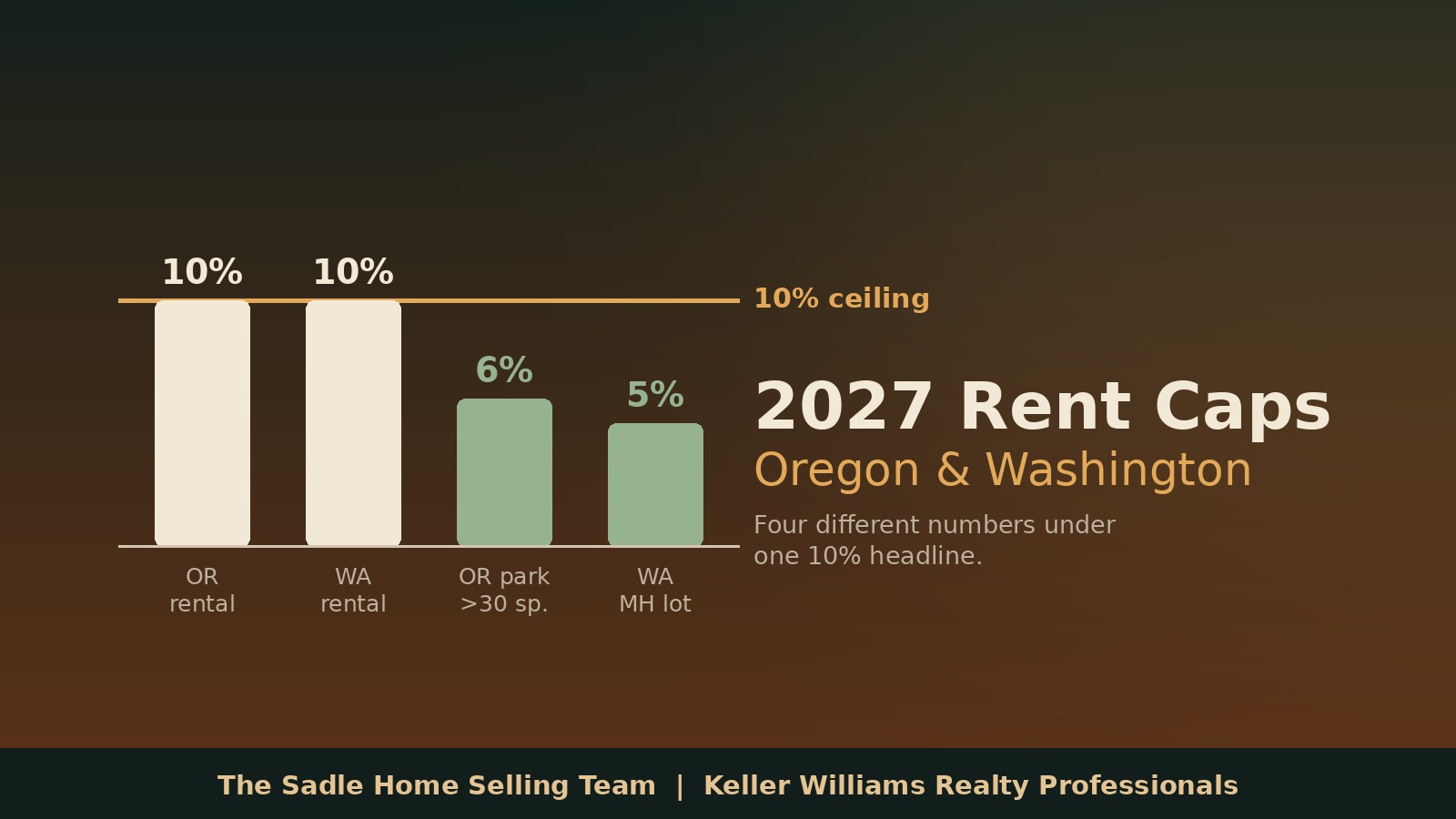
The 10% headline hides four different numbers
Both states use the same basic formula: the lower of 10%, or 7% plus the Consumer Price Index. For 2027, the CPI calculation landed above 10% in both states. Washington's figure, for example, came to 11.53%. The statutory ceiling pulled both states back to 10%.
Then they diverge.
- Ordinary Oregon rentals (ORS 90.323): 10% for 2027, up from 9.5% in 2026.
- Oregon manufactured-home parks with more than 30 spaces: 6%. This is a flat statutory number, not a CPI calculation, and it does not move with the formula.
- Oregon manufactured-home parks with 30 or fewer spaces: the same 10% as ordinary rentals.
- Ordinary Washington rentals: 10% for 2027, up from 9.683% in 2026.
- Washington manufactured and mobile home lots: 5%, flat.
So a landlord with a $700 lot rent in a large Oregon park can raise it $42 a month. The same lot rent in Washington moves $35. On an ordinary $2,200 rental, the 10% ceiling allows $220 a month, or $2,640 over a year.
Put the year-over-year change in perspective. On a $2,200 rental, Oregon's move from 9.5% to 10% adds only $11 a month—$132 a year—to the maximum increase. Washington's change adds about $7 a month. That's not enough by itself to justify holding a property that no longer works as an investment.
Your rental might be exempt, and the two states draw the line differently
The exemption rules matter more than the half-point changes in the headline cap, and this is where Oregon and Washington really separate.
Oregon exempts a unit whose first certificate of occupancy is less than 15 years old as of the date of the rent increase notice. Washington exempts a unit whose first certificate of occupancy was issued 12 or fewer years before the notice. Three years of difference, and it decides whether you have a cap at all.
Neither state allows a rent increase during the first year of a tenancy. In Oregon, that's the first year after the tenancy begins; in Washington, it's the first 12 months. The permitted increase isn't smaller during that period. It's zero.
Washington goes further than Oregon on owner-occupied situations. Under RCW 59.18.710, the cap doesn't reach a single-family residence the owner lives in while renting no more than two units or bedrooms, a duplex, triplex, or fourplex where the owner occupies one unit as a principal residence, or a unit where the tenant shares a kitchen or bathroom with the resident owner. Oregon has no comparable carve-out.
Here's the Washington rule landlords often get backward: a regular rental house you do not live in is covered by the cap. The exemption turns on owner occupancy, not whether the property is a single-family home. Both states also exempt housing regulated or certified as affordable through a government program.
If your Camas rental was built in 2016 and your Sellwood rental in 2011, you have two different sets of rules on two properties — and that's before anyone asks about the tenants themselves, which brings its own set of rules when you go to sell.
Notice rules, and the local layer most landlords forget
Both states require 90 days' written notice before a residential rent increase takes effect. Oregon drops that to 7 days for week-to-week tenancies. Washington allows 30 days where rent is subsidized and based on tenant income, and 60 days for certain leases signed before May 7, 2025. Manufactured-home park owners in Washington owe three months.
Work backward from the effective date: January 1, 2027 means notice by October 3, 2026. February 1 means November 3. March 1 means December 1. Miss a deadline and the increase moves back a full month.
Then there's the part that isn't state law at all.
Vancouver adopted a Rental Registration Program in July 2025. Registration opened January 1, 2026, and the 90-day free window closed March 31, 2026. The fee is $30 per unit per year, and 2027 registrations are due by February 15, 2027. Owner-occupied single-family housing is exempt, and fees are waived for units under legal affordability restrictions. The city has said health and safety inspections begin in mid-2027; registration is all that's running today.
Portland has required annual Residential Rental Registration since 2018 under City Code 7.02.890. You file Schedule R with your City of Portland and Multnomah County business tax return, generally due April 15. The fee was $70 per unit for tax year 2025, the most recent year the city has published. Units guaranteed affordable under HUD guidelines for households at or below 60% of median household income are exempt.
A four-plex, then: $120 a year to register in Vancouver, $280 in Portland. That's not a reason to buy on one side of the river — the property tax picture moves far more money than registration fees do. But if you own on both sides, these are two separate filings with two separate deadlines, and neither office reminds you.
What this actually changes if you're deciding whether to sell
Probably less than the headline makes it sound.
A 10% cap is a ceiling, not an automatic raise. Market rents across Portland and Vancouver generally aren't supporting double-digit increases right now. For most owners I talk with, the legal cap isn't the real limit—the tenant's willingness to renew is. The owners most affected are those whose rents have fallen well below market after years of capped increases, and even a 10% increase may not close that gap.
What has changed is the amount of compliance work. Vancouver's mid-2027 inspections bring a real cost and some unanswered questions, and they arrive alongside the 2027 registration deadline. If you've treated your rental as a passive hold, the next eighteen months will require more attention than the last eighteen.
That's the number worth running: not whether the cap moved from 9.5% to 10%, but whether the property still earns the work it requires. And that math turns on your basis, your rate, your equity, and the capital gains clock, which is where the sell-or-rent decision is usually won or lost.
This is exactly the kind of question I walk investor clients through before anyone lists anything. The cap is a fact you can look up. Whether to hold isn't.
Frequently Asked Questions
Can my landlord raise my rent 10% in 2027?
Only if the unit is subject to the cap and the increase is properly noticed. Both Oregon and Washington set the 2027 maximum at 10%, but no increase is allowed during the first year of a tenancy, and newer buildings are exempt — less than 15 years from certificate of occupancy in Oregon, 12 or fewer years in Washington. 10% is a ceiling, not an entitlement.
Is a single-family rental house covered by Washington's rent cap?
Yes, if you don't live in it. Washington's exemption under RCW 59.18.710 covers a single-family residence the owner occupies while renting no more than two units or bedrooms. A standard rental house with no owner on site is subject to the cap unless its first certificate of occupancy is 12 or fewer years old.
How much notice do I have to give for a 2027 rent increase?
90 days' written notice in both states for a standard residential tenancy. Oregon allows 7 days for week-to-week tenancies. Washington allows 30 days for income-based subsidized rent and 60 days for some leases signed before May 7, 2025, and Washington manufactured-home park owners must give three months.
Do I have to register my Vancouver rental, and what does it cost?
Yes, unless it's owner-occupied single-family housing. Registration runs $30 per unit per year, and 2027 registrations are due by February 15, 2027. Vancouver has said health and safety inspections start in mid-2027.
Does Oregon's 6% park cap apply to my manufactured home?
Only if the facility has more than 30 spaces — Oregon caps those at a flat 6% for 2027. Parks with 30 or fewer spaces follow the same 10% maximum as ordinary rentals. In Washington, manufactured and mobile home lots are capped at 5%.
Both states landed on 10% for 2027, but your actual limit depends on the property's age, how long the tenant has lived there, which side of the river the property is on, and whether you occupy it. Get any of those details wrong and the notice may not hold up.
If you own a rental in Portland or Vancouver and you're deciding between another year as a landlord and selling, send me the address. I'll help you compare the registration costs, inspection exposure, current equity, and what the property could actually sell for today.
Sources
- Oregon Department of Administrative Services, Office of Economic Analysis — Rent Stabilization (2027 and 2026 Oregon maximums; 6% large-park figure)
- ORS 90.324 — Maximum annual rent increase percentage
- ORS 90.323 — Rent increase limits, exemptions, and notice
- Washington Department of Commerce — HB 1217 Landlord Resource Center (2027 and 2026 Washington maximums)
- RCW 59.18.710 — Exemptions from the rent increase limit
- RCW 59.18.140 — Notice requirements for rent increases
- Washington Attorney General — Manufactured/Mobile Home Landlord-Tenant Act (5% lot cap, three months' notice, first-12-month rule)
- City of Vancouver, WA — Rental Registration Program
- City of Portland — Residential Rental Registration Fee
A note on scope: I'm a licensed real estate broker, not a CPA or an attorney. Rent stabilization rules, exemption tests, and local registration requirements turn on facts specific to your property and your tenancy, and they change. Confirm your own situation with a landlord-tenant attorney or your tax professional before you send a notice or make a filing decision.
About Rick Sadle
Rick Sadle is the Principal Broker and CEO of The Sadle Home Selling Team at Keller Williams Realty Professionals, serving the Portland, Oregon and Vancouver, Washington real estate markets. With more than 20 years of real estate experience, over 3,500 homes sold and more than $1 billion in team sales volume, Rick is one of the Portland area's most experienced real estate professionals. He is also a weekly real estate expert on KXL 101 FM, where he discusses the Portland and Vancouver housing markets, mortgage rates, housing trends and the economy. Rick is an Oregon-licensed Principal Broker and Washington-licensed Broker.
or another way