
Published September 24, 2026
Do You Need a Seismic Retrofit to Sell Your Portland Home?

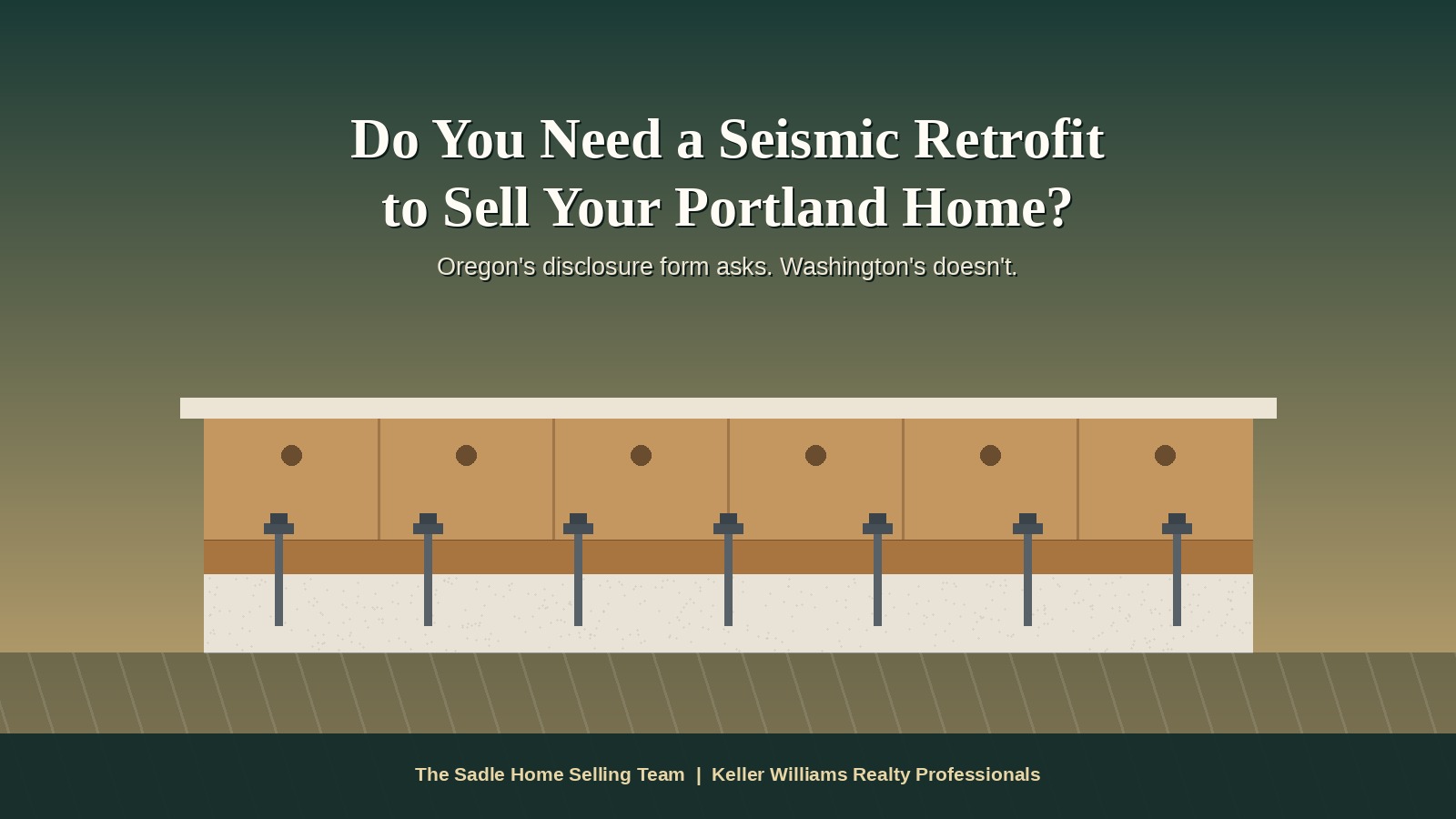
Do you have to seismically retrofit your Portland home before selling it?
No. Oregon and the City of Portland do not require you to retrofit your home before you sell it. But if the house was built before 1974, Oregon's disclosure form asks whether it has been bolted to the foundation. You have to answer, and buyers pay attention when the answer is "No" or "Unknown." Washington's Form 17 does not ask the same question, so this issue comes up differently on the Vancouver side of the river.
By Rick Sadle | September 22, 2026
I get this call pretty regularly from sellers in neighborhoods like Alameda, Laurelhurst, and Sellwood-Moreland. They have a contractor's estimate in hand, the number is bigger than they expected, and the house is supposed to hit the market in a couple of weeks. Do they have to do the work before they sell?
You don't. But you do need to disclose what you know and have a plan for the questions buyers are likely to ask.
There is one question on the Oregon disclosure forms that sometimes catches sellers off guard
Oregon's Seller's Property Disclosure Statement is set by statute — the actual form text lives in ORS 105.464. Buried near the end, after the sections on water, sewage, and dwelling systems, is Section 8. It is two lines long:
8. SEISMIC
Was the house constructed before 1974? Yes / No / Unknown
If yes, has the house been bolted to its foundation? Yes / No / Unknown
That's the whole question. It doesn't require you to fix anything or hire an engineer. It simply requires an honest answer based on what you know about the property.
This applies to a lot of Portland homes. The Craftsman bungalows and Foursquares in Alameda, Irvington, and Sellwood-Moreland were built well before 1974, as were many of the mid-century ranches in Southwest Portland.
And the City of Portland is direct about what that means. Per Portland Permitting & Development, many homes built before 1960 were never bolted to their foundations at all — until the 1950s, builders often didn't bolt the mud sill down. The City also notes that some wood-frame homes built as recently as the 1970s came off their foundations in past earthquakes despite being bolted, because the cripple walls underneath were braced only with stucco or wood siding instead of plywood.
So "bolted" and "strengthened" aren't the same thing. You can honestly answer Yes to Section 8 and still have a weak cripple wall.
One practical note: If you truly don't know, "Unknown" is a valid answer. Don't guess. The disclosure is based on what you actually know when you sign it, and claiming something you never verified can create a much bigger problem than simply saying you don't know.
Section 8 also isn't the only place this shows up. Section 9 asks whether there's been material damage from earthquake, expansive soils, or landslides, and whether the property sits in a designated slide or geologic hazard zone. On the hillier lots in the West Hills and parts of Southwest Portland, those questions do real work.
Washington's Form 17 doesn't ask — and that matters in Vancouver
Cross the Columbia and the form changes completely. Washington's seller disclosure statement is set by RCW 64.06.020, and its Section 4 (Structural) asks about roof leaks, basement flooding, unpermitted conversions, the age of the house, settling or slippage, and defects in a checklist that includes foundations.
What it does not contain is any question about seismic bolting. There is no Washington equivalent to Oregon's Section 8.
That's worth knowing if you're selling in Camas, Washougal, Felida, or Salmon Creek. It doesn't mean the seismic risk stops at the Columbia. It only means Oregon puts the bolting question directly in front of the buyer and Washington doesn't. If you own on both sides of the river or you're moving from one state to the other, this is one of several differences in the paperwork. I've written a fuller comparison of what sellers must disclose in Oregon versus Washington if you want the whole picture.
In Portland, buyers and their agents know to look at Section 8. The inspector may check the crawl space specifically for bolting and bracing. A "No" or "Unknown" answer usually isn't a deal-killer, but you should expect it to come up during the inspection period.
Should you retrofit before listing, or disclose and move on?
This is where the decision becomes specific to your house, your budget, and your timeline.
Retrofitting is a permitted project. The City of Portland requires a building permit for residential seismic strengthening. That's not red tape for its own sake — the permit gets you an inspection and a permanent record, and that record is exactly what you hand a buyer. An undocumented retrofit is worth much less to you at the negotiating table than a permitted, finaled one.
Portland publishes a prescriptive method so most homeowners don't need a custom engineered design. Your house qualifies for it if:
- It's a one- or two-family dwelling, no more than three stories
- Cripple walls don't exceed four feet in one- and two-story buildings
- In three-story buildings, cripple wall stud height is no more than 14 inches
- There's a continuous concrete foundation around the entire perimeter
- The foundation subgrade isn't steeper than three horizontal to one vertical
That last one matters on Portland's hillsides. If your lot is steeper than 3:1, the City requires an engineer or architect to prepare the plans, and your cost and timeline both go up.
The prescriptive scope itself is fairly defined. Anchor bolts go into the mud sill roughly every six feet on a one-story home and every four feet on a two- or three-story home, with the first bolt nine to twelve inches from the end of each board. Plywood bracing covers 40% of the cripple wall length on a one-story home, 50% on a two-story, and 80% on a three-story.
To make that concrete: a single-story home with a 30-by-50-foot footprint has a 160-foot perimeter. That's roughly 27 anchor bolts and about 64 linear feet of plywood — around sixteen four-foot sheets.
What will it cost? I wouldn't trust a generic number from a blog post. The price depends on the house: whether it has cripple walls, how much blocking is needed, how tight the crawl space is, and whether the contractor finds dry rot, termite damage, or an unreinforced masonry foundation. The City doesn't publish a standard price and recommends getting at least three bids. I agree. Get the bids first, then decide whether the work makes sense for your sale.
Here's how I usually look at it with sellers. If an inspection finds rot or crumbling concrete that needs to be repaired anyway, and you have enough time before listing, adding the seismic work may make sense while the contractor is already in the crawl space. If you're only a few weeks from listing and the foundation is sound, an accurate disclosure and realistic pricing may be better than rushing into a project that won't be finished before the first open house.
What I'd steer you away from is the middle path: starting the work, not finishing the permit, and heading into escrow with an open permit on the property. That's a genuine complication. It's the same problem I see with unpermitted work more generally — an unfinished record is harder to sell around than an honest disclosure.
The City does note that strengthened homes are easier to sell and insure. That's a reasonable general statement, not a promise about your sale price. What I can tell you from this market is that a documented retrofit removes a question from the buyer's list, and in a market where buyers have more choice than they did two years ago, having one fewer open question is worth something real.
One more option worth knowing about: Portland offers a free 15-minute appointment with a Residential Building Code Reviewer. If you're on the fence, that's a no-cost way to find out what your house would actually need before you spend anything.
Frequently Asked Questions
Is a seismic retrofit required by law to sell a house in Oregon?
No. Oregon has no statute requiring a seismic retrofit as a condition of sale, and the City of Portland doesn't require one either. What Oregon requires is disclosure — Section 8 of the seller's property disclosure statement asks whether a pre-1974 home has been bolted to its foundation.
What happens if I answer "Unknown" on the seismic question?
Nothing automatic. The disclosure form is based on your actual knowledge, and "Unknown" is a valid answer if you truly don't know. Practically, expect the buyer's inspector to look at the crawl space and expect a follow-up question during the inspection period.
Do I need a permit to seismically strengthen my Portland home?
Yes. Portland Permitting & Development requires a building permit for residential seismic strengthening. The permit provides an inspection and a permanent record, and that finaled record is what gives the work value when you sell.
Does Washington require seismic disclosure when selling in Vancouver or Camas?
No. Washington's Form 17, set by RCW 64.06.020, has no seismic or foundation-bolting question. Its structural section covers settling, slippage, foundation defects, and the age of the home, but it does not ask about bolting.
Can I do the bolting myself?
The City says the prescriptive work can be done by a homeowner with basic carpentry skills, though most people hire contractors who specialize in it. Either way you still need the permit and the inspection — and for a home you're about to sell, that inspection record is most of the point.
If you're trying to decide whether to retrofit before selling, let's look at the house and the timing before you spend the money. The right answer for a 1912 bungalow in Alameda may be completely different from the right answer for a 1978 split-level in Salmon Creek. I'm happy to talk it through with you.
Sources
- ORS 105.464 — Form of seller's property disclosure statement (Oregon Revised Statutes; Section 8 SEISMIC and Section 9 GENERAL)
- RCW 64.06.020 — Improved residential real property disclosure statement (Form 17) (Revised Code of Washington; Section 4 STRUCTURAL)
- Residential Seismic Strengthening — Portland Permitting & Development, City of Portland (prescriptive criteria, permit requirement, bolt spacing, plywood bracing percentages, cost guidance)
I'm a real estate broker, not a CPA, an attorney, or a structural engineer. This article describes disclosure requirements and City of Portland permitting guidance as I read them as of September 2026; rules change, and your property may have conditions this article doesn't cover. Confirm your specifics with a licensed structural engineer, your attorney, and Portland Permitting & Development before you make a decision.
About Rick Sadle
Rick Sadle is the Principal Broker and CEO of The Sadle Home Selling Team at Keller Williams Realty Professionals, serving the Portland, Oregon and Vancouver, Washington real estate markets. With more than 20 years of real estate experience, over 3,500 homes sold and more than $1 billion in team sales volume, Rick is one of the Portland area's most experienced real estate professionals. He is also a weekly real estate expert on KXL 101 FM, where he discusses the Portland and Vancouver housing markets, mortgage rates, housing trends and the economy. Rick is an Oregon-licensed Principal Broker and Washington-licensed Broker.
or another way