
Published September 14, 2026
Selling a House With Unpermitted Work in Portland or Vancouver

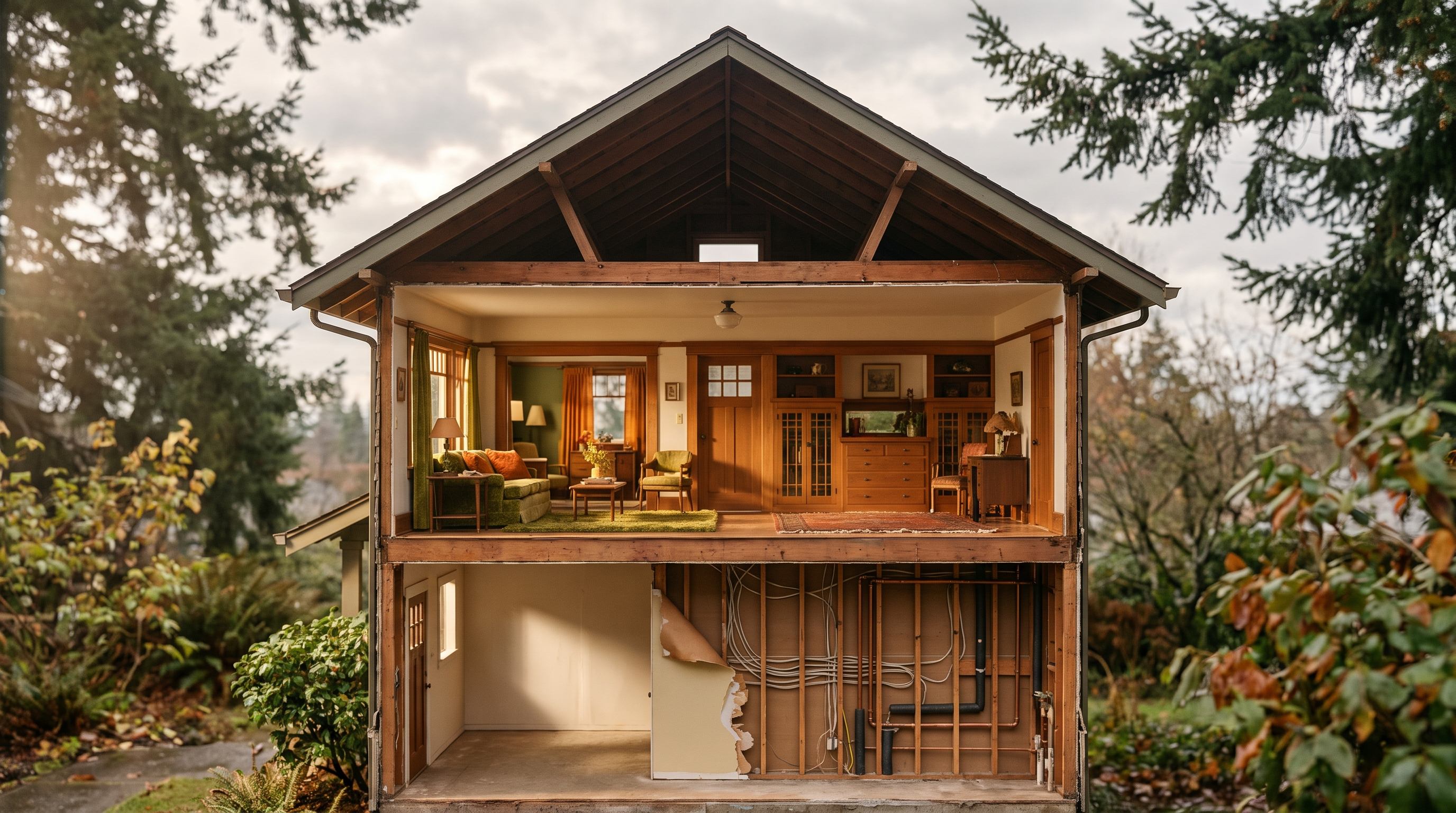
Can you sell a house with unpermitted work in Portland or Vancouver?
Yes. Neither Oregon nor Washington bars you from selling a home that has unpermitted work in it. What both states require is that you answer the disclosure question honestly — and both seller disclosure forms ask about it directly, including whether a final inspection was ever obtained. The real decision isn't whether you can sell. It's whether you permit the work before you list, disclose it and price for it, or let the buyer decide how to handle it.
By Rick Sadle | September 13, 2026
This comes up more than almost anything else in older Portland and Vancouver housing stock. A finished basement in Sellwood-Moreland. A converted garage in Felida. A bathroom somebody's brother-in-law added in 2011. A deck off the back of a Foursquare in Alameda that nobody ever pulled a permit for.
Most of the time the seller didn't do the work. They inherited it from the previous owner and only find out when a buyer's agent pulls the permit history during the inspection period — which happens far more often now than it did five years ago, because the records are free and take about ninety seconds to search.
Here's how I walk sellers through it.
What you actually have to disclose
This is where sellers get into trouble, and it's the part worth reading slowly.
In Oregon, the Seller's Property Disclosure Statement is set by statute — the form text lives in ORS 105.464. Section 5, "Dwelling Structure," asks:
- Are there any additions, conversions or remodeling?
- If yes, was a building permit required?
- If yes, was a building permit obtained?
- If yes, was final inspection obtained?
Read that last line again. Oregon asks separately whether the permit was finaled. A surprising number of Portland homes have an open permit — work that was permitted, started, inspected once or twice, and then never signed off. On the form, that is not the same as "yes, we got a permit."
In Washington, Form 17 is set by RCW 64.06.020. Section 4, "Structural," asks:
- Have there been any conversions, additions, or remodeling?
- If yes, were all building permits obtained?
- If yes, were all final inspections obtained?
All three of those questions carry an asterisk, and the form's own instructions say that if you answer "Yes" to an asterisked question you must explain your answer and attach documents where available. So in Washington you don't just check a box — you write it out.
The timing matters too. Washington sellers deliver Form 17 within five business days of mutual acceptance, and the buyer then has three business days to rescind, in the buyer's sole discretion, and get their deposit back (RCW 64.06.030). That is a no-questions-asked exit. If your disclosure is the first the buyer hears about a converted garage, you have handed them a clean way out of the contract.
Oregon runs on a similar principle from the other direction: if the seller doesn't deliver the disclosure statement at all, the buyer can revoke the offer any time before closing.
None of this makes unpermitted work a deal-killer. It makes surprise unpermitted work a deal-killer. The same dynamic shows up across the whole disclosure process — I go deeper on the two forms in this comparison of Oregon and Washington seller disclosure.
What it costs to permit it after the fact
Every jurisdiction in this metro lets you get an after-the-fact permit. They all charge you extra for it, and — this is the part most sellers don't expect — they charge you extra in three completely different ways depending on which side of a line your house sits on.
City of Vancouver. Under Vancouver Municipal Code 17.08.130, anyone who starts work before getting the permit is charged an investigation fee, and the code says that fee "shall be the same as the required permit fees contained in the fee tables." In plain terms: it doubles. The code also notes the investigation fee may be on top of any other penalty assessed under VMC Title 22.
Unincorporated Clark County. Clark County Code 6.140.020(3) takes the same approach — when work is started before the permit is obtained, the fees "shall be doubled." Run a real number on it. A $60,000 basement finish in unincorporated Clark County carries a permit fee of about $688.50, plan review at 65% of that (about $447.52), a $94 issuance fee, and a $4.50 state fee — roughly $1,234 all in. The doubling adds about another $1,136, putting you near $2,371 before you've paid a contractor a dime.
City of Portland. Portland does not double. Portland Permitting & Development's adopted fee schedule carries a separate line — "Investigation Fee: For commencement of work before obtaining a permit" — charged hourly, with a minimum. Portland's underlying permit costs are higher to begin with: that same $60,000 project runs roughly $865 in building permit fee, about $211 in the residential development services fee, and about $563 in plan review — around $1,639 before the investigation fee, state surcharge, or any separate electrical, plumbing, or mechanical permits.
The money is usually not the real cost anyway. The real cost is exposure. To finalize an after-the-fact permit, an inspector has to see the work — which means opening walls and ceilings so framing, wiring, and plumbing can be verified. If something doesn't meet code, it gets corrected before the permit finals. Budget for drywall repair and paint on top of the fees, and budget time: this is measured in weeks, not days.
One more wrinkle worth knowing. If the unpermitted space is a full second living unit, you're in different territory entirely — that's an ADU question, not a remodel question, and the rules and paperwork are their own animal. I covered that in selling a home with an ADU in Portland or Vancouver.
What I tell sellers to do, in order
1. Pull the permit history before you list. Portland records are searchable free at PortlandMaps, and Clark County has an online permit lookup. Do this first, for two reasons: you may find the work was permitted and you just didn't have the paperwork, and if it wasn't, you'd rather learn it now than during the inspection period.
2. Figure out what the work actually is. A deck, a bathroom, and a bedroom added in a basement are three very different problems. Sleeping rooms have egress-window and ceiling-height requirements that are the most common reason an after-the-fact basement bedroom can't be finaled as a bedroom. That matters for more than code — an appraiser may not be able to count that square footage, which can move your value.
3. Decide among four real options.
- Permit it now. Cleanest outcome, most expensive, slowest. Best when the work is good and the exposure is limited.
- Disclose it and price for it. Very common, and completely legitimate. The buyer knows what they're getting and the price reflects it.
- Disclose it and offer a credit toward permitting, so the buyer controls the process on their timeline.
- Reverse it. Sometimes the cheapest path for a small item is removing it rather than permitting it.
4. Tell your lender contact early. Financing is where this quietly kills deals. Some loan programs and appraisers treat unpermitted finished space differently than permitted space, and it's better to find out in week one than in week four.
Which of the four is right depends on the work, the price point, and how your specific buyer pool is behaving right now. That's the conversation I have with sellers before we put a sign in the yard, not after an inspection report shows up. If yours is already under contract and this just surfaced, the same logic applies — you can see how the repair-or-credit negotiation usually plays out in what happens after a home inspection here.
Frequently Asked Questions
Do I have to disclose unpermitted work if I didn't do it?
Yes. Both forms ask what you know about the property, not what you personally built. If you know a previous owner converted the garage, that's a disclosable fact. "I didn't do it" is not an exemption — though you can and should say so in your written explanation.
What if I genuinely don't know whether a permit was pulled?
Both forms have an "Unknown" or "Don't know" option, and using it honestly is legitimate. But pull the permit record anyway. Checking "unknown" on something that takes two minutes to look up isn't a great look if a dispute comes later.
Will a buyer's lender refuse the loan over unpermitted work?
Not automatically. It depends on the loan program, the appraiser, and whether the work affects habitability or safety. Health-and-safety items — electrical and structural especially — draw the most scrutiny. Get the lender looking at it early rather than late.
Can the city make a buyer tear out unpermitted work after closing?
Enforcement generally attaches to the property and the current owner, which is exactly why buyers care so much. That risk transferring to them is the reason it shows up in price negotiation.
Is it cheaper to permit in Vancouver or Portland?
They're structured differently, so it depends on project size. Vancouver and unincorporated Clark County double the permit and plan review fees. Portland charges a separate hourly investigation fee on top of base permit costs that start higher. On a small project Portland's approach can cost more; on a large one, doubling usually hurts worse.
The bottom line
Unpermitted work is a pricing and disclosure problem, not a "you can't sell" problem. Sellers who find it early, document it, and decide deliberately tend to move through it without much drama. Sellers who find out during the inspection period are negotiating from behind.
If you've got a finished basement, a converted garage, or a permit you're not sure ever got finaled, I'm happy to pull the record with you and talk through which of the four options actually fits your house and your timeline. Reach out anytime.
Sources
- ORS 105.464 — Form of seller's property disclosure statement (Section 5, Dwelling Structure)
- ORS 105.465 — Application; disclosure statement
- RCW 64.06.020 — Seller's disclosure statement (Form 17), Section 4 Structural
- RCW 64.06.030 — Delivery of disclosure statement; buyer's options; time frame
- Vancouver Municipal Code 17.08.130 — Fees (work commencing before permit issuance)
- Clark County Code 6.140.020 — Fees payable and 6.140.030 — Building fees table
- Portland City Code 24.10.070 — Application for Permits
- Portland Permitting & Development — Building and Other Permits Fee Schedule (effective July 10, 2026)
Fee figures are current as of September 11, 2026 and are illustrations based on the adopted fee schedules cited above. Permit valuation is determined by the building official, and your actual cost will differ. I'm a real estate broker, not an attorney or a CPA — confirm anything legal, tax, or code-related with the appropriate professional or directly with the permitting office for your jurisdiction.
About Rick Sadle
Rick Sadle is the Principal Broker and CEO of The Sadle Home Selling Team at Keller Williams Realty Professionals, serving the Portland, Oregon and Vancouver, Washington real estate markets. With more than 20 years of real estate experience, over 3,500 homes sold and more than $1 billion in team sales volume, Rick is one of the Portland area's most experienced real estate professionals. He is also a weekly real estate expert on KXL 101 FM, where he discusses the Portland and Vancouver housing markets, mortgage rates, housing trends and the economy. Rick is an Oregon-licensed Principal Broker and Washington-licensed Broker.
or another way